
The Pallavicini Family of Hungary
and their Algyö-Mindszent Estate
A SPOTLITE™ Presentation by Vic Berecz.

|
The Pallavicini Family of Hungary |
|
|
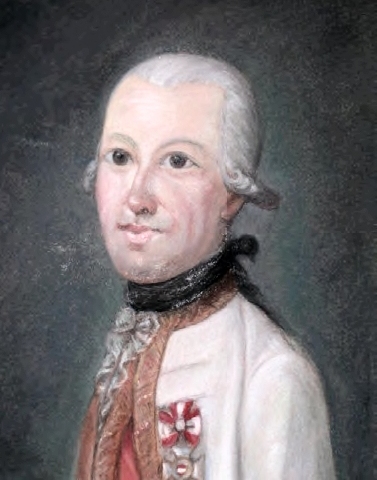
Pallavicini's Come to the Habsburg Empire Gianluca Pallavicini (1697-1773) was from the branch of an old, noble Lombardy family that was involved in banking in Genoa. In 1731 he was sent by Genoa as ambassador to the Habsburg Emperor-King, Charles III. He soon entered Charles' service and during the 1735-9 Austro-Russian-Turkish War commanded an Austrian army along the Danube. In 1846, he was injured during the Siege of Parma in the War of the Austrian Succession. He was appointed viceroy for Austria's re-occupied northern Italian provinces. He recommended his nephew, Giancarlo, to Empress Maria Theresia for an Imperial Army commission.
Acquisition of the Algyö-Mindszent Estate. After southern Hungary was recovered from the Turks, there was a scramble for land among Hungary's
elite. Count György Erdödy ended up controlling a huge swath of land along the Tisza River between Kecskemét and
Szeged. He was granted a royal deed in 1733. Erdödy was killed in battle in 1758. His son Kristóf was a poor manager
and very big spender. He became deeply in debt to Genovese bankers named Pallavicini. By 1775, the entire Estate
was pledged as collateral for the loans. In 1792 Kristóf Erdödy was declared bankrupt and various interests began
fighting over the assets. Then Napolean captured Genoa. As a result, the Estate was declared "enemy held" property
and was subject to confiscation. In an effort to salvage something from their loans, the Genovese Pallavicini's
proposed to turn over their interest in the Estate to Hungarian family members. The widow and minor son of Giancarlo
were the beneficiaries. His widow, Leopoldina was from the second wealthiest and most powerful
family in Hungary ... the Zichy's of Várpalota ... so the deal could hardly be denied.
Click here |
The Algyö-Mindszent Estate in the 19th Century The "sale" of the Estate to Giancarlo's estate was approved by the King in 1804. Many other creditors
and interested parties objected. It wasn't until 1827 that the dust settled. A part (including what is now the
Opusztaszer National Park) was separated from the Estate. The son, Eduárd, was officially granted Hungarian
citizenship, and ownership of the remaining 66,000 acres. Objections persisted until, in 1835, an unwell Eduárd
deeded full control of the estate to his mother to ensure it would not be broken up further, and would pass to his
descendants. He died in 1839.
Eduárd married Countess Josephine von Hardegg-Glatz and they had six sons. The oldest and heir was Alfonz
(1807-1875). In 1842, Alfonz bought what became the Pallavicini Palace in Vienna and spent little time on the
Algyö Estate, preferring the aristocratic life in Vienna. He was soon appointed Imperial Chamberlain (manager
of the Imperial household) and was an Army General. From 1861 until his death, he was a member of the Upper
House of the Hungarian National Assembly (Parliament).
The consensus of reports seems to indicate that the Algyö-Mindszent estate was well-run and very productive in the
1830s and 1840s when it was under the direction of Leopoldina Zichy and her estate manager József Palásty. The Estate had large numbers of sheep and cattle, the typical grain crops, and increasing dependence on tobacco,
which the peasants found to be a lucrative cash crop. Leopoldina Zichy, our ancestor's great benefactress, died
in 1846. After the war for independence, when all feudal obligations were eliminated, difficulties began largely
resulting from the decision to stop growing the soil-depleting tobacco. This decision may have resulted in
József Palásty's death.
A quarter of a century later, the devastating flood of the Tisza River in 1879 wiped out the entire village of
Algyö (except for the church) including the Pallavicini manor house, which was on the river bank but hadn't been
used by the family for several years. Sándor Pallavicini (1853-1933), son of Alfonz, donated 300 hectares of uplands ...
which was part of the family's hunting preserve ... to the villagers to re-establish themselves. This was the
beginning of the village now known as Sándorfalva, named in his honor.
Click here: |
 to see an early 19th century map of the Estate with a present-day map
of the same area ... all of the green is now a National Park and
two Wildlife Refuges.
to see an early 19th century map of the Estate with a present-day map
of the same area ... all of the green is now a National Park and
two Wildlife Refuges.
 to see a Descendant Listing
of the Austro-Hungarian branch of the Pallavicini family ... and here:
to see a Descendant Listing
of the Austro-Hungarian branch of the Pallavicini family ... and here:
 to view a photo gallery relating to the Pallavicini family and their Algyö-Mindszent Estate.