Your Roots in Historic Hungary
by Vic Berecz
4. The Family
History Library (FHL) On-Line.
Background. One of the great resources family history researchers have at their disposal is the Family History Library (FHL) maintained by the Church of Jesus Christ of Latter-Day Saints – often referred to as the LDS Church, and its members as Mormons. While the FHL is a brick-and-mortar establishment associated with that church’s headquarters in Salt Lake City, Utah, there is also a significant, and growing, Internet presence for the FHL. That will be the focus of this article.
But, the major resource of the FHL, especially for those of us researching ancestors in historic Hungary, is their collection of microfilmed records. They maintain well over 10,000 rolls of microfilm with records of historic Hungary. These are not yet available on-line – though an on-going project promises to make them available on-line by 2015.
These include the church registers of virtually every church that existed in the 1830-1895 period in the territory associated with present-day Hungary. Personally, I’ve researched the church registers of over one-hundred towns. To date, there is only one church I know of whose registers are not available on FHL microfilms … that exception is the Reformed church of Mór in Fejér county. Without a trip to Salt Lake, this vast array of microfilmed resources are available to you at a local Family History Center (FHC), most of which are located in LDS Church facilities. A second focus of this article will be on using the on-line resources to determine which microfilms you want to study at an FHC. The next article will describe how to use that FHC.
Many non-Mormons do not understand the
rationale for the LDS Church’s huge investment in records to support
genealogical research. According to Wikipedia,
“The LDS church holds that deceased
persons who have not accepted or had the opportunity to accept the gospel of
Christ in this life will have the opportunity to accept the gospel in the
afterlife … [and] they must also receive all the ordinances that a living
person is expected to receive, including baptism. For this reason, members of
the LDS Church are encouraged to seek out their genealogy. … Latter-day Saints
complete genealogical work for deceased persons and if it is determined an
individual has not received some or all of the saving ordinances, the
individual's name is submitted to the temple to receive these ordinances by
proxy. Optimally, the proxy who stands in will be a descendant of the deceased
person, but the ordinance proxy may also be an unrelated volunteer.”
The genealogy
resources of the FHL are available to all, without regard to their own
religion. As a practicing Lutheran, I have made regular and extensive use of
FHL resources for almost twenty years, and I very much appreciate the support
of the FHL and the volunteers at the local FHC’s that I use in my family
history research.
Overview of
the FHL Website: Start by
visiting the homepage of www.FamilySearch.org
-- this is the top-level webpage tht includes all FHL information. Here note that you can download for free
a copy of the Personal Ancestral File (PAF) v5.2. This is a basic, widely-used genealogy
software product. I personally use another
product – RootsMagic v3.2.4 – for its superior graphics and other
features. But, if you have never used
genealogy software, PAF may be a very good place to start.
You may wish to
experiment with the Search feature on the home page of the website, or
the more complete search feature you will find under the “Search” tab. But, information for people in historic
Hungary is quite limited in the Ancestral File and the International
Geological Index – the two principal databases for continental Europe that
are presently available in the Search feature. The “Share” tab is for those who wish to share their findings
with others. We will not deal with that
feature here.
Therefore,
let’s go directly to the “Library” tab.
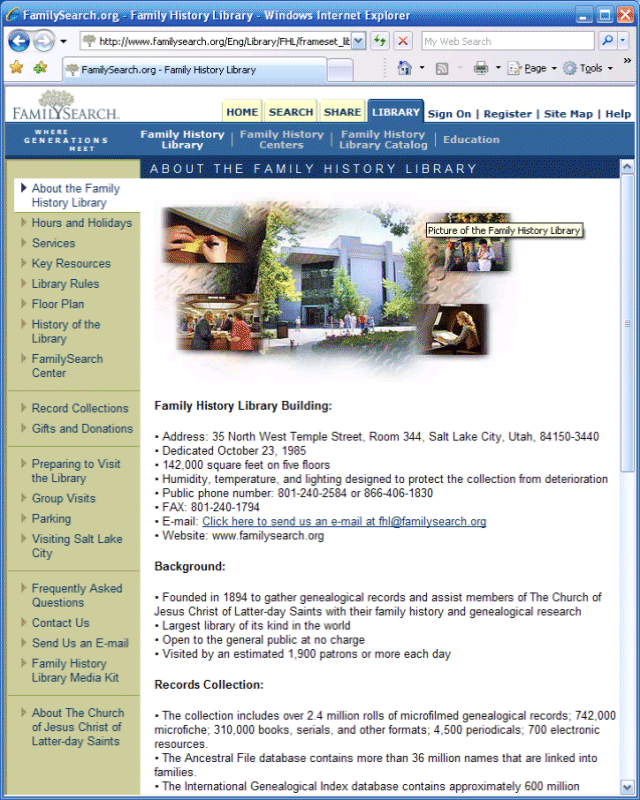
Fig 4-01 illustrates a part of the Library
homepage. The homepage provides some
interesting statistics about the scope of the FHL, and at the left has a menu
of options, primarily of interest to users of the library in Salt Lake City.
The second tab labeled “Family History Centers” takes you to a search-engine
that finds for you FHC’s in a particular area.
If you are unsure of the location of an FHC in your area, this will give
you the address, phone number, and hours of operation. I have personally used the FHC’s in Fort
Myers, FL and Bloomfield and Woodbridge, CT.
Those readers
in the Connecticut area will find the Woodbridge FHC of particular
interest. Because of the large number
of Hungarian-Americans and Slovak-Americans in southwestern Connecticut, the volunteers
in this FHC are particularly knowledgeable in the genealogy of historic
Hungary. Also, there are literally
hundreds of reels of microfilm containing records of historic Hungary on
permanent loan to this center. These
are freely available to all patrons.
The fourth tab
labeled “Education” lists a variety of educational opportunities
available. These are provided by both
the FHL and outside organizations. One
of these is a free on-line version of Brigham Young University’s course
titled Religion 261: Introduction to Family History. Some of you may be interested in pursuing
this more formal approach to educating yourself in family history research.
The third tab –
“Family History Library Catalog” – is the key element of the website for our
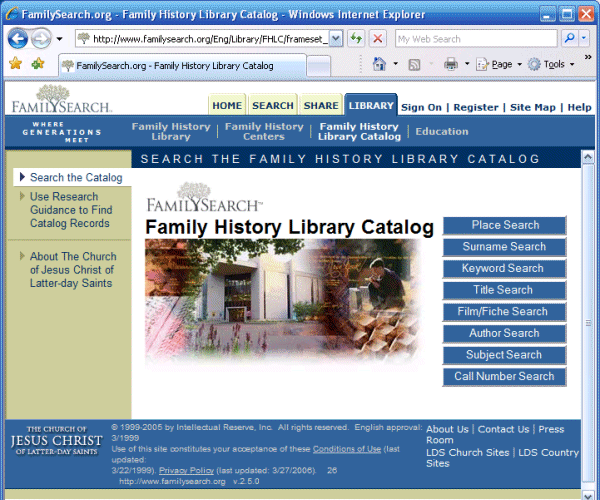
purposes. Click on the tab and see the
webpage shown in Fig 4-02. As with most library catalogs, it may be
searched in a variety of ways. If you
are interested in books, you may search by Title or Author. For compiled genealogies, the Surname
search may be useful. But we are
interested primarily in microfilms, and we don’t know them by Film Number. Therefore, most frequently researchers of
historic Hungary will use the Place Search feature.
But first, a
little background. Most of the FHL’s
microfilms covering places in present-day Hungary were filmed in Budapest in
the 1960s. Two master copies were made
– one went to the FHL, the other to the Hungarian archives. So, the material available in the FHL is
identical to the archives in Budapest – no need to travel there to access this
information. Over subsequent decades,
extensive filming was done of historic Hungarian records elsewhere … first in
Slovenia and Austrian Burgenland, and more recently in Croatia and
Slovakia. Unfortunately, little filming
has been done to date in the parts of Serbia, Romania, and the Ukraine which
were in historic Hungary.
Use of the Place
Search Feature: One
of the four basic pieces of information that we sought for your immigrant
ancestors is their town of birth. To
see which, if any, records are available for those towns you will use Place
Search in the FHL Catalog. For my
example, I will use the small city of Sárvár in Vas county in the northwest of
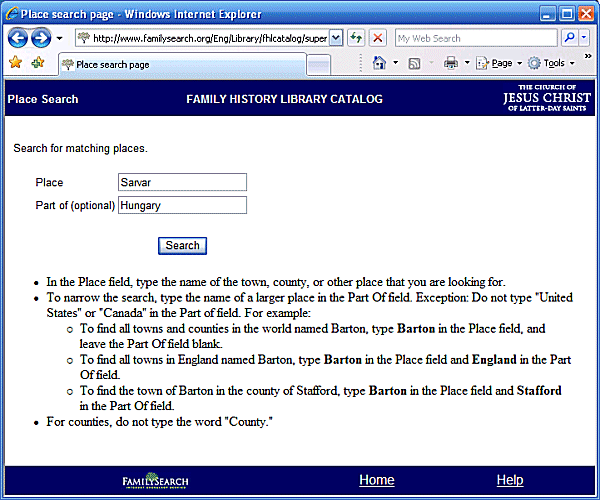
present-day Hungary. Fig 4-03 shows the Place Search page with the
entry for my sample search. You may
wish to try the same search to see the features mentioned, but not illustrated
below. Note that when using Place
Search, you do not enter any diacritical marks (accents, umlauts,
etc).
I usually use
the optional Part of feature in Place Search. Since returned places are anything that
begins with the letters you specify, this eliminates many extraneous results
from other parts of the world. But,
when you are working with towns that were a part of historic Hungary, but are
not a part of present-day Hungary, make sure you are consistent in Place
and Part of – use the Hungarian place name with “Hungary” but if you use
the current place name, make certain you use the current country name. For instance: Puczincz, Hungary will produce
the same results as Puconci, Slovenia … but Puconci, Hungary will get you
nowhere!
Now back to our
Sárvár example. When you click Search
you will see two entries (not illustrated).
One is for Hungary, Vas, Sárvár – note that the name is correctly
accented, and the county is identified as Vas.
But, there is a second entry for Sárvár (kerület) – or Sárvár
region. “Kerület” entries usually refer
to the records of a military base in the area of the town, and so will not be
further discussed here.
The next step
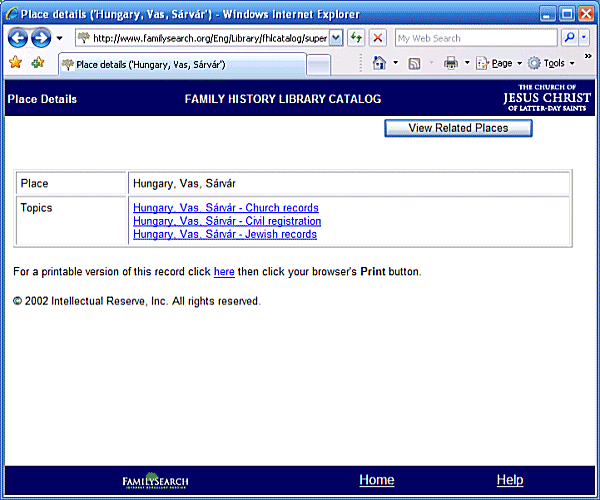
is to click on the link to Hungary, Vas, Sárvár. The result is shown in Fig 4-04. Now we see that the FHL has three types of
records for this city: a) Church
Records – for towns in present-day Hungary these usually go only to 1895;
b) Civil Registration – these records usually go from 1895 and end
before World War I; they only exist for the larger towns with notary offices;
and c) Jewish Records – which obviously exist only in places with a
Jewish congregation. Explore the Civil
Registration link on your own, and you will see that there were separate
notary offices for the city of Sárvár and the surrounding villages. If you check out the Jewish records, you
will see these also end in 1895 when Hungary changed from church to civil
registration of births, marriages, and deaths.
But, only rarely do Jewish records go back earlier than 1830. Note the button at the upper-right reading View
Related Places – that’s important, more about it later.
If we click on Church
Records, we see (not illustrated) that there were two churches in Sárvár –
Roman Catholic and Evangelical (Lutheran).
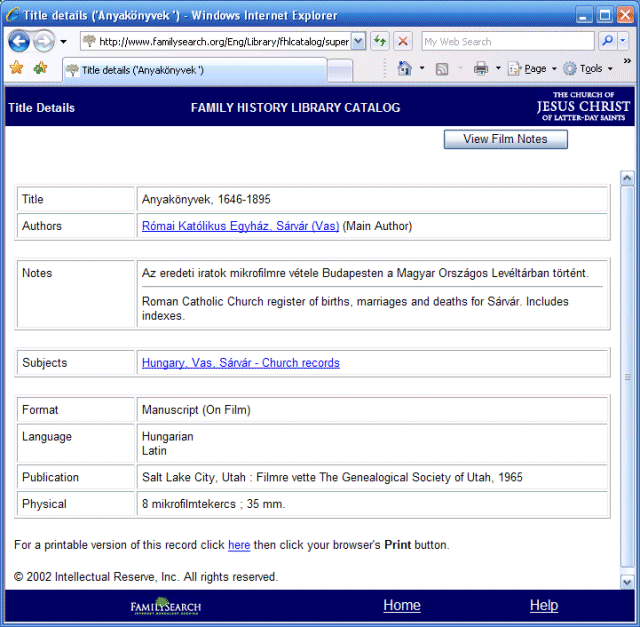
We will continue our example with the Roman Catholic church. The catalog shows that the Catholic church
registers (anyakönyvek) go from 1646-1895. This is an extremely long period and their existence is likely
due to the fact that the northwestern part of present-day Hungary was never
occupied by the Turks.
Clicking on the
link for the Roman Catholic church gives us further information about those
church records, as seen in Fig 4-05. Here we find that the records were filmed in
1965, are in the Hungarian and Latin languages, are on eight rolls of
microfilm, and include indices.
Wow! If you’re from a Catholic
family that lived in Sárvár, you’ll have a field-day!
The last step
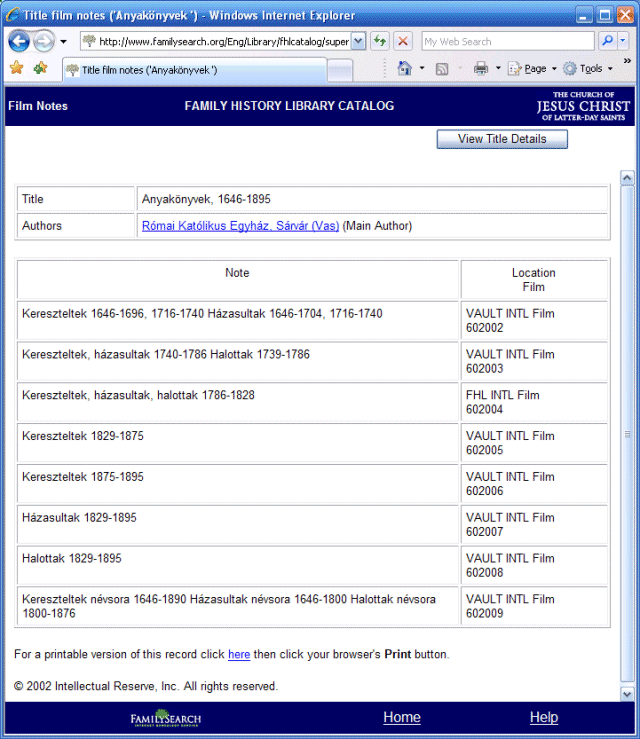
in Place Search is to click on that little button at the upper-right
that says View Film Notes. Here
we will see exactly what is on each roll of film as well as the film numbers
needed for ordering. The film notes for
the Sárvár Catholic church are seen in Fig 4-06. At the left is a description of the contents
of each of the eight films, and at the right is the seven-digit film number for
ordering. [Note: if there are less than
7 digits, add leading 0’s – most Hungarian records filmed in the 1960s begin
with 06.] Looking over the notes, we
see that deaths (halottak) were not recorded until 1739. Also, we see that there is a gap in the
records of baptisms (kereszteltek) and marriages (házasultak)
during the period of the Rákoczi rebellion at the beginning of the 18th
century. Finally we see that the last
film is an index of baptisms, marriages, and deaths for the entire period. Such indices are extremely rare and very
valuable to researchers when they are available. That’s the end of the example.
The next step is to order films at your local FHC … that process will be
covered in the next article in this series.
This all sounds
so easy, but what if you enter a place name and your search results in that
terrible message: No Matching Places Found? Many small villages did not have a church … people used a church
in a neighboring town or village. A map
may help with this problem, but there is better approach that will yield only
the names of towns for which the FHL has records. If you enter into the original Place Search webpage the
name of a county rather than the name of a town (Vas for instance),
you’ll get a set of results that always includes includes county information …
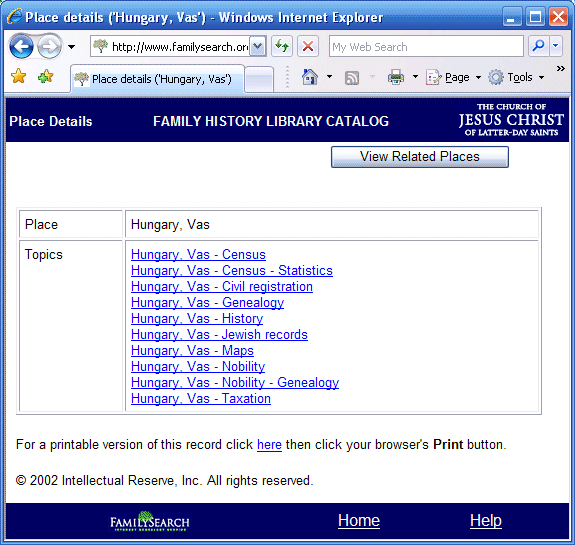
in this case that entry will simply read Hungary, Vas. Click on that entry and you will get a page
that looks like Fig 4-07 listing all the
categories of information available in the FHL for that county. Many of these appear to be of great interest
to a family history researcher, and we may deal with some of them in future
articles. But, that’s not our point
here. Instead, click on the button at
the upper-right that reads View Related Places. That will give you a list of all the towns
in the county which have entries in the FHL catalog. The resulting webpage is not shown here because in Vas county
there are 333 places listed … but try it yourself. Now, with this list on-screen, use that map to find one of these
places near the village you’re looking for.
Another advantage of this list is that it shows the spelling used in the
catalog … often you may have difficulty with placenames that include prefixes
(like Alsó meaning “lower”) or with more than one word (like Szent-György). These are sometime hypenated, sometimes run
together.
Explore this example yourself to get a feel for the options and types of information available. Then move on the the towns where your immigrant ancestors originated. Enjoy!
Summary. The next article will address how to work with microfilms at a Family History Center, once you have the film number(s) you’d like to use. I’d like to tailor subsequent articles to reader’s interests. Therefore, your feedback would be appreciated. Write me at Vic@Berecz.us
Next: Using your Local Family History Center.