Your Roots in Historic Hungary
by Vic Berecz
5. Using
Your Local Family History Center (FHC).
Background. In the previous article, you learned how to use the FHL catalog on-line to identify the microfilms that may be of interest in your family history research. Also discussed was how to locate a Family History Center in your area. That on-line search-engine will provide you the address, phone number, and hours of operation of each FHC in the area you specify. Another approach to locating FHC’s is the telephone Yellow Pages. Under “Churches” check for either “LDS” or “Mormon” – most but not all LDS churches have a FHC on-site. There are also a few FHC’s that are located in licensed facilities other than LDS churches – the Godfrey Memorial Library in Middletown, CT is an example.
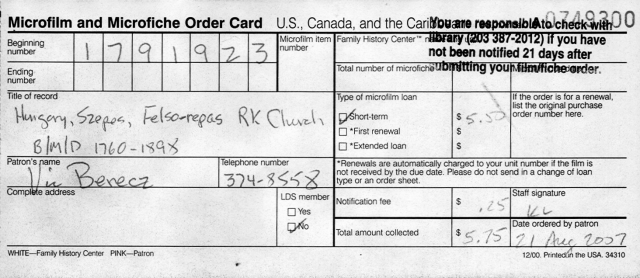
Ordering Microfilms. The first step is to order one or more microfilms. This must be done in person at an FHC, they do not take orders over the phone. Your first visit will be a good opportunity to get your bearings, meet the staff, see what facilities and resources are available and order those films. [Note: as with most libraries, FHC’s don’t permit briefcases or bags inside the library work areas … too many films and other materials seem to walk. Bring only what you need to do your research, and carry it in plain view.] Ordering films involves filling out a Microfilm and Microfiche Order Card – usually one for each film. A sample order card is shown in Fig 5-01. Here are the basic ground rules for filling out these order cards:
Film Number: Put the seven-digit film number in the Beginning number area. Add leading zeros, if necessary, to make the film number seven digits. If you are ordering an inclusive sequence of films, you may use one card to order several films by putting the last film number of the sequence in the Ending number area.
Title of Film: Put a descriptive title in the Title of record area. This is used as a check to ensure that a film number wasn’t in error. Also, this is how your film will be labeled when it arrives, so it should be meaningful to you also. It is strongly recommended that the title begin with the origin of the records: country, county, town – for instance: Hungary, Szepes, Felso-repas. Note that accents and other diacritical marks are not used. Typically, I then identify the denomination of the church whose registers are on the film: RK for Roman Catholic, GK for Greek Catholic, Evan for Evangelical Lutheran, Ref for Reformed, etc. and then I abbreviate the content, in this case Births/Marriages/Deaths for the period 1760-1898. Note that the church register in this example was not filmed in Hungary in the 1960s, but rather in the archives in Levoca, Slovakia in 1992. Therefore, you might have accessed the same film using Slovak names and identified it as being from: Slovakia, Levoca, Vysne Repase.
User Info: Fill in your name, phone number, address and whether or not you are an LDS member. Your address is only necessary the first time you use a given FHC. They will get it into their computer and from then on your name and phone number is sufficient to identify you.
Length of Loan: The only other thing you need to fill out is the Type of microfilm loan – I suggest always checking Short-term even if you think you may want to keep the film permanently at that FHC. You can always extend the loan later, after you’re certain there’s a lot of useful information on the film. Short-term generally implies one-month from the arrival date. The First renewal is for a second month, and an Extended loan leaves the film permanently at that FHC. Minor variations from a “month” sometimes result since films are returned to Salt Lake City in batches, usually once a week.
Cost of Films: The rest of the card is filled out by FHC volunteer staffers, who also enter the order into their local computer system. The cost of a film loan is $5.50 for each loan period (payable by cash or check when ordering or extending) – therefore, the cost is a maximum of $16.50 to keep a film permanently at your FHC. Usually 25¢ is added for the phone call to notify you that your film has arrived. These fees are pretty standard, but I have seen one FHC that charged slightly different rates.
Delivery Time: Normally, films arrive within two-to-three weeks of the order date. Occasionally films are “back-ordered” to await return of a film or to have another copy made from a master. But, if you haven’t heard from the FHC in three weeks, call them to make sure there wasn’t a notification mix-up.
Hints for Working with Church Registers on Microfilms.
When your film comes in and you visit the FHC to begin working with it, the first hurdle is how to use the film reader. At most FHC’s there are two types of film readers – low and high-magnification. The high-magnification readers are only required for 8mm films. Almost all of the films of historic Hungary are 35mm and so the much more numerous low-magnification readers are perfectly adequate. A staff member will be happy to show you how to use a reader and help you get started.
There are usually several items on a given film. Often these represent different volumes of the church registers from a given church. Volumes are sometimes completely chronological, containing births, marriages, deaths, and perhaps confirmations for a specific period. In other cases, a volume contains only one type of record – say marriages – for some period. [Note: from a church perspective it is only baptisms, marriages, and burials that are important, but from about 1830 to 1895 the churches were mandated to also record the birth date and death date. That’s why I simplify and talk about B/M/D’s. Before 1867, infants were often baptized on the day of birth. Burial usually took place two days after death. But, of course, there were many exceptions and variations.] In the case of very small churches, the records of more than one church may be among the items on a film. Also, you will occasionally find that a volume has been split between two films.
Therefore, I recommend that when you start to use a film the first thing you do is scan the entire film to get an overview of what’s on it. Make sure it’s the correct film, mislabeling occasionally happens. Determine the items that are of interest to you. Evaluate the condition of the records and the language(s) used … that may help you to plan your work. Here’s a general sense of the condition you can expect … post-1867 records are usually excellent and very legible; 1780-1867 records are very mixed and go from poor to excellent; pre-1780 records also vary, but from totally illegible to reasonably good. The biggest problem with church registers of historic Hungary is ink “bleeding” through the paper making it difficult to read the reverse side. Less frequently, pages are filmed which are discolored due to aging or have become brittle with edges that have broken away. Always remember, it could be worse … Hungarian records don’t have the tropical staining and insect damage that’s so pervasive in relatively recent registers from places like Colombia in South America!
I wish I could tell you what you can find on your selected films, and how to go about finding it. But, every film is different, as are our individual work habits and preferences. So my only suggestion is to prepare yourself for the types of records you hope to find and the languages you will encounter. One way to do that is to review in detail the Document Examples section of my Hungarian Family History Tutorial. You will find about twenty examples of actual church registers from the early 1700s to the late 1800s for the Roman Catholic, Reformed, and Lutheran traditions and a remarkable example of five language changes in less than 50 years in the death register of a Greek Catholic church. The notes associated with these documents include considerable information about both the Latin and Magyar terms used in baptismal, marriage, and burial records.
When you find information about your ancestors – and you almost certainly will – I’m sure you will want to take copious notes on what you find. [Note: most FHC’s permit the use of laptop computers, and there are electrical outlets that can be used.] But, you may also want to make copies of the original records. Some people do this using their own digital camera. Usually there’s enough light, and for legible individual entries digital cameras will often do a decent job. The other alternative is to use a microfilm printer. These are very expensive machines, and usually only one of them is available at each FHC. Since every microfilm printer I’ve seen is different, you’ll need to get instruction from the staff in using it. But, three things are common and so worth mentioning. First, you must move the film from the reader to the printer with both reels in place. Second, fast scanning of a film is not possible on a printer, so don’t plan to make copies from all over a long film at one sitting. And finally – the good part – the microfilm printers have interchangeable lenses going from very low to extremely high-magnification. This means you can print entire pages or zoom-in on just a few words if that’s what you want. Also, the microfilm printers support negative-positive inversion. So, the few films which are entirely negative (white on black) can be inverted to print in the much more legible positive form (black on white). The cost of copies from a microfilm printer is somewhat more than those from a standard copier – typically 25¢ per page.
Summary. This completes the five-part series I originally contemplated to help get readers started on the search for their roots in historic Hungary. I hope to continue the series in the summer of 2008 with additional articles keyed to the specific needs and interests of readers. To do this, your feedback is needed. I look forward to your e-mails, write me at Vic@Berecz.us